

Section-0: HOW TO READ THIS ISSUE: A USER MANUAL FOR DEEP ATTENTION 🧠
This is not a content snack. This is a meal.
If you are reading this while walking to the elevator, half-listening in a meeting, or waiting for a Zoom call to connect, stop. Bookmark this page. Close the tab. Come back when you have at least twenty minutes of uninterrupted silence and a cup of coffee, tea, or whatever tells your body:
“Now I’m not in notification mode. I’m in thinking mode.”
Why this insistence on attention?
Because we are about to question something you almost never see directly:
– the way your education was structured,
– the way your organization is designed,
– the way you have been taught to think about expertise, strategy, and career,
– the hidden assumption that if you pick one discipline and go deep, the world will line up for you.
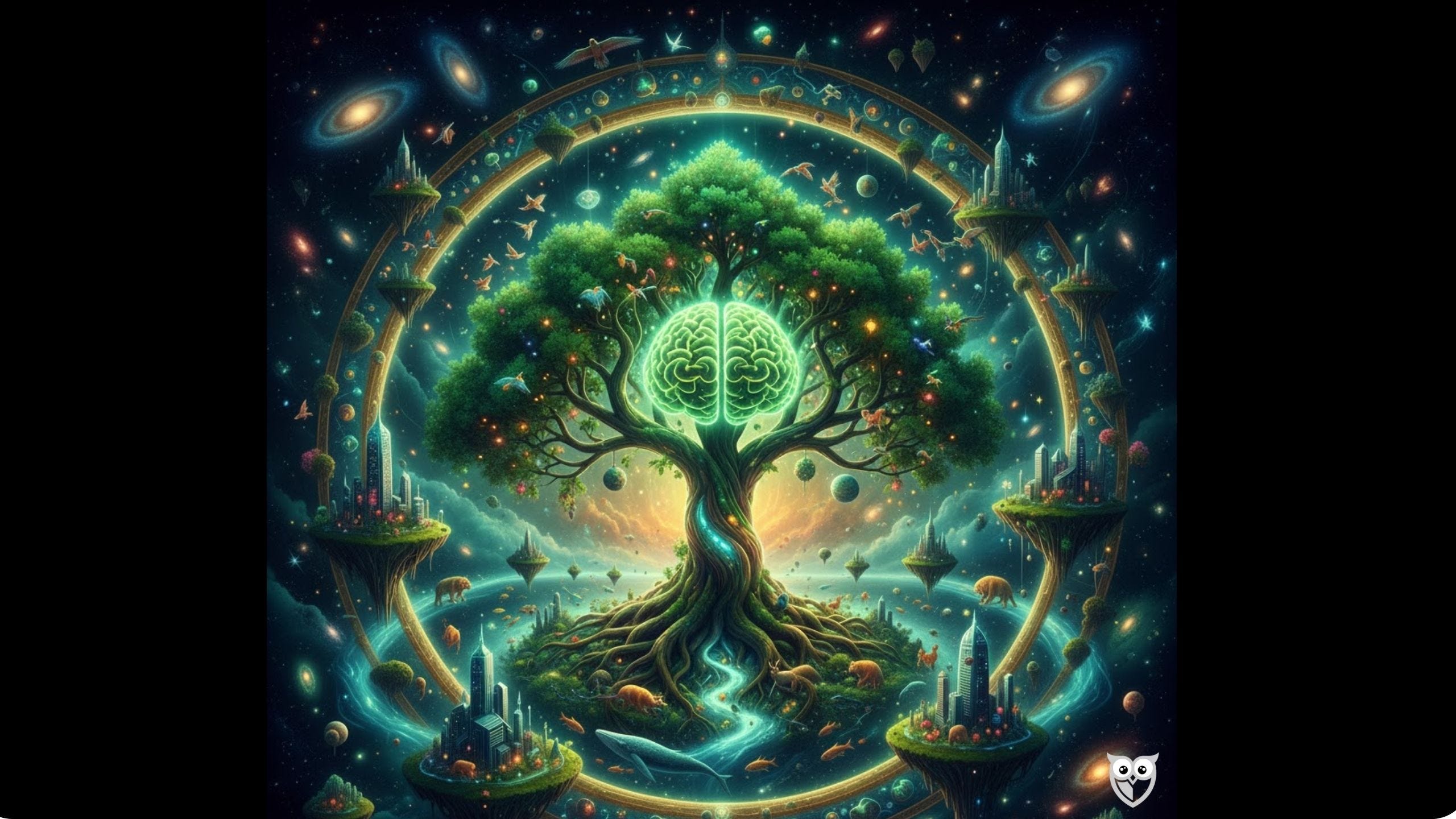
For more than a century, the dominant promise has been:
“Pick a discipline. Specialize. Become an expert. The world will reward you for it.”
That promise is not entirely false. Specialization did give us vaccines, semiconductors, modern logistics, and a thousand other miracles.
But a half-true story can become dangerous when the environment changes.
We now live in a world where:
– crises interact with each other,
– technologies rewrite the rules faster than institutions can respond,
– local events propagate through global networks in hours,
– and every meaningful decision sits at the intersection of multiple systems.
In such a world, intelligence that stays inside a single disciplinary box is not just incomplete. It is misleading.
Think of this inaugural issue not as a “post”, but as a hidden magazine: a long-form ecosystem letter that just happens to live on a social platform.
It contains:
– one overarching thesis – why single-discipline thinking fails in a complex world,
– historical case studies – places and periods where people already experimented with ecosystem-like thinking,
– a philosophical framework – what we mean by “ecosystem sciences” and how it relates to existing fields,
– a practical toolkit – specific exercises you can run in your own context this week.
You do not have to read everything in one sitting. But whatever you read, read it as if it matters. Because it does.
Navigating the Depth
You can choose your way through this text:
The Skimmer’s Route
If you are strictly time-bound, read Section 1 – The Problem, to see why your current mental maps may be failing you, and Section 7 – The Toolkit, to get a concrete, five-day ecosystem practice you can test in your own life.
The Leader’s Route
If you are a founder, CEO, Board Member, director, or senior leader, dive deep into Sections 3 and 5. These sections show what happens when organizations cling to castle thinking and how to redesign leadership habits around ecosystems rather than silos.
The Educator’s Route
If you work with youth, universities, schools, or learning communities, focus on Sections 3 and 6. They propose a shift from preparing students for fixed job titles to preparing them for ecosystem roles in a moving, non-linear landscape.
The Weekend Read
If you are a researcher, thinker, designer, policy maker, or simply an ecosystem nerd, read the whole thing, start to finish. It is written as a single narrative arc: we start with the problem, we learn from history, we build a shared language, and we land in practice and invitation.
You will notice deliberate repetition. That is not a layout bug; it is a design choice. Ecosystem thinking is not one insight you “get” and move on from; it is a mental habit you strengthen, like a muscle.
How to Hold This Text While You Read
Three small practices will change how this manifesto lands for you:
Keep One Real Ecosystem in Mind
Continuously ask: “If this paragraph is true, what does it say about my ecosystem?”
Watch for Defensiveness
– “This doesn’t apply to us; we’re different.”
– “We already do cross-functional work.”
– “This is philosophy. I need something pragmatic.”
When that happens, don’t throw the text away. Treat that reaction as data: a sign that an existing mental model is being challenged.
Take Notes Like a Cartographer, Not a Student
If you are ready, let’s start by looking honestly at the maps we inherited.
Section-1: THE PROBLEM: WE ARE MAPMAKERS USING OUTDATED GEOGRAPHY 🗺️
Before we talk about “ecosystem intelligence,” we need to be honest about the maps we are using to navigate reality.
Those maps were drawn:
– in a different century,
– for different technologies,
– under different risks,
– with a different pace of change in mind.
We have changed our devices, our tools, and our platforms. We have not upgraded the underlying mental cartography that tells us what is “inside” our discipline and what is “someone else’s job.”
We still live, study, and make decisions as if the world has departments.
Reality doesn’t.
1.1. The Industrial Legacy: The Assembly Line of Knowledge
Most of our modern institutions were architected in the late 19th and early 20th centuries:
– the modern research university,
– the large industrial corporation,
– the civil service and many government agencies,
– professional guilds and licensing bodies.
This was the age of Fordism and Taylorism:
– the assembly line as a symbol of efficiency,
– scientific management, time-and-motion studies, optimizing each worker as if they were a part in a machine.
In that context, the guiding idea was reductionism:
“If you want to understand a complex machine, you take it apart.”
You study each component separately. You optimize each part.
Then you reassemble and expect the whole to be improved.
We applied this logic not only to machines, but to reality itself. We decided the world could be safely disassembled into neat, non-overlapping categories:
– If it involves money, it belongs to Economics.
– If it involves cells, it belongs to Biology.
– If it involves society, it belongs to Sociology.
– If it involves building things, it belongs to Engineering.
– If it involves meaning, it belongs to Philosophy or Theology.
We built faculties, departments, job descriptions, compensation schemes, and career ladders on top of that fragmentation.
And we told generations of students: “If you study one discipline deeply enough, you will understand the world, and you will find a secure place within it.”
This architecture gave us a workforce of highly trained specialists, each brilliant at optimizing their own part of the machine — and often blind to the machine as a whole.
So today we have:
– excellent economists who do not understand thermodynamics or ecology,
– brilliant engineers who do not understand sociology or collective behavior,
– skilled politicians who do not understand algorithmic bias or platform dynamics,
– influential technologists who do not understand history, law, or ethics.
Everyone is intelligent. But intelligence is fragmented.
From the inside, this fragmentation feels normal. You are rewarded for depth, for focus, for staying in your lane. From the outside, it starts to look like this:
“A group of very smart people, all pulling hard in different directions, inside a system nobody quite understands.”
This is how we walk, with great confidence, into crises we did not intend to create.
1.2. The Reality Check: The World Doesn’t Have Departments
The fundamental error of the 20th century was assuming that reality cares about our academic and organizational boundaries.
It doesn’t.
The most pressing challenges of our time are wicked problems:
– they are messy,
– they are interconnected,
– they don’t stay in one box,
– and every “solution” changes the problem itself.
A few examples:
The Climate Crisis
On paper, it might look like an environmental or engineering problem: “Reduce emissions.” In reality, it is simultaneously climate science, energy systems, geopolitics, finance, psychology and behavior, urban planning, colonial history, culture and media narratives.
Try to solve it with engineering alone and you hit political walls.
Try to solve it with a purely economic tool (carbon taxes) and you hit social equity walls.
Try to solve it with communication campaigns alone and you hit infrastructure walls.
A Social Media Platform
On the surface, it is “just an app.” In reality it is:
– a piece of code,
– a global broadcasting network,
– a psychological stimulus machine,
– a reputation and attention marketplace,
– a political battleground,
– and a youth mental health environment.
It is Code + Attention + Storytelling + Advertising + Regulation + Mental Health + Culture.
When a tech CEO says, “We are just a platform,” they are not being neutral. They are admitting they lack ecosystem intelligence.
The Future of Work
In HR documents, it may show up as “talent strategy” or “reskilling.” In reality, it is a collision of:
– automation and AI,
– education policy,
– social safety nets and welfare models,
– identity and purpose,
– migration and demographics,
– the deep human search for meaning.
Yet, walk into almost any boardroom, cabinet meeting, academic committee, or strategy workshop and you will hear the familiar echoes of the assembly line:
– “That’s a marketing problem.”
– “That’s a legal risk; send it to Legal.”
– “That’s a technology issue; ask Engineering.”
– “That’s HR’s job.”
We break reality into pieces, send each piece to a different room, and then we are genuinely surprised when the assembled “solution” explodes on contact with the real world.
It is not that people are stupid or malicious. It is that the structure of thinking is still based on a world that no longer exists.
1.3. The Three Illusions of Single-Discipline Thinking
When we force complex reality into siloed thinking, we fall prey to three persistent cognitive illusions. These illusions are especially powerful in intelligent, high-performing environments, because they are reinforced by local success data.
The Control Illusion
– “If Marketing improves acquisition by 20%, the business will be fine.”
– “If Engineering reduces latency, user happiness will follow.”
– “If Finance cuts costs, resilience will automatically increase.”
In complex systems, this is often false. Optimizing a single variable can destabilize the whole.
For example:
– Make your supply chain hyper-efficient and you may remove all buffers, making the system fragile to shocks.
– Push employees to maximum productivity and you may quietly build a burnout epidemic that shows up in quality problems two years later.
The Blame Illusion
“It wasn’t us. We followed the rules. We did our job.”
And they are right — locally. Compliance is perfect. Metrics are green. Everyone can be right, and the system can still die.
This is how we get financial crashes no single trader planned, environmental disasters no single company “caused,” and social crises no single algorithm “decided.”
The Local Optimum Illusion
– market share in one segment,
– test scores in one subject,
– response time in one system,
– satisfaction within one stakeholder group.
Almost nobody is asking: “Are we even in the right mountain range?”
Local optimizations become traps; we sacrifice systemic health for small, visible wins in one corner of the map.
The result:
We have built a civilization with extremely sophisticated partial intelligence, and dangerously weak ecosystem intelligence.
Why This Becomes Fatal in a “Polycrisis” Era
We now live in what many call a polycrisis:
– multiple crises,
– interacting with each other,
– across domains,
– amplified by speed, scale, and connectivity.
Climate events feed political instability.
Political instability feeds migration crises.
Migration crises feed cultural polarization.
Polarization feeds algorithm design.
Algorithm design feeds attention economies.
Attention economies feed mental health trends.
These are not separate fires. They are interacting ecosystems of risk.
In such a landscape:
– Narrow technical fixes without systemic understanding create new problems.
– Policy changes without cultural understanding backfire.
– Technological advances without ethical framing erode trust.
Single-discipline thinking doesn’t just fail to capture the full picture. It actively misleads us. It gives us a false sense of control in systems where linear control does not exist.
To navigate a polycrisis world, we need a different kind of literacy. We call it ecosystem intelligence.
Before we define it, we first need to reclaim a word that has been stretched thin by marketing and buzzwords: “ecosystem”.
Section-2: WHAT WE MEAN BY “ECOSYSTEM SCIENCES” 🔭
“Ecosystem” has become a fashionable word.
– Software companies talk about “developer ecosystems.”
– Startups talk about “innovation ecosystems.”
– Brands talk about “content ecosystems.”
Sometimes this is useful. Often it is decorative.
At the Institute of Ecosystem Sciences, we are trying to do something more old-fashioned and more ambitious:
To treat ecosystems as a serious, rigorous object of study, and to build a field that lives between and across existing disciplines.
We are not the first to think this way. Ecologists, systems theorists, and complexity scientists have been doing this for decades. But their insights rarely make it intact into boardrooms, classrooms, or city halls.
We want to change that.
2.1. Ecosystem: Our Working Definition
We use “ecosystem” in a pragmatic, structural sense.
Whether we are looking at:
– a coral reef,
– a neighborhood,
– a national education system,
– a startup community,
– a digital platform,
– or a family,
we see the same underlying structure:
An ecosystem is a set of actors, resources, rules, and stories connected through feedback loops over time.
Let’s unpack the components:
Actors: Who is in the system?
– Not just the obvious leaders or formal roles,
– but also the marginalized groups, the “invisible” workers,
– and the non-human actors: algorithms, infrastructure, climate patterns, legal codes, pathogens, machines.
Resources: What flows through the system?
It is rarely just money.
– Time and attention
– Trust and reputation
– Energy and materials
– Information and data
– Status and legitimacy
Rules: What governs behavior?
– Formal rules: laws, contracts, policies, regulations.
– Informal rules: culture, taboos, unspoken agreements, “how things are done here.”
Often, informal rules explain more behavior than the formal ones.
Stories: What gives meaning and direction?
– “We are the innovators.”
– “We must always grow.”
– “Nothing ever changes here.”
– “People like us don’t get seats at that table.”
Stories are not decoration. They are the software running the ecosystem. They tell actors what is possible, what is allowed, and what is expected.
Feedback Loops: How do actions reinforce or balance each other over time?
– Positive (reinforcing) loops: growth begets growth, panic begets panic.
– Negative (balancing) loops: regulations, social norms, physical limits that stabilize the system.
Feedback loops are the engine of the ecosystem. Without feedback, you don’t have an ecosystem; you have a list.
This definition is simple on purpose. It is a shared lens you can use across domains. Ecosystem Sciences is the effort to refine that lens, add tools to it, and put it to work in real systems.
2.2. A Crossing, Not a Kingdom
We do not intend to build “Ecosystem Sciences” as a new academic fortress with its own departments, journals, and gatekeepers.
We see it as a crossing — a trading post where existing disciplines meet to exchange tools and test questions together.
From different fields, we borrow and integrate:
From Ecology & Biology
– resilience,
– carrying capacity,
– diversity and monoculture,
– adaptation and evolution.
We learn that monocultures are efficient in the short term but fragile over time, while diverse systems look inefficient but survive shocks.
From Sociology & Anthropology
– tribalism and group identity,
– status games and power,
– rituals, norms, and trust,
– how communities remember and forget.
We learn that systems are not just technical, they are social. Who talks to whom, who is excluded, and which stories are allowed to be told matter as much as any engineering diagram.
From Economics & Management
– incentives and trade-offs,
– resource allocation,
– externalities,
– organizational design.
We learn that every system must manage energy and value flows, and that what we call “externalities” are often simply feedback loops we choose not to track.
From Complexity Science & Systems Theory
– non-linearity,
– tipping points,
– emergence,
– path dependence,
– network effects.
We learn that cause and effect are rarely simple and that small interventions in the right place at the right time can have disproportionately large effects.
From Philosophy & Ethics
– normative questions: What is good? For whom? At what cost?
– responsibility and agency,
– justice and fairness.
We learn that a system can be efficient and still be unacceptable. A well-designed ecosystem is not just stable; it is also just.
From Art & Design
– visualization,
– storytelling,
– experience design,
– the capacity to make the invisible visible.
We learn that data alone does not change behavior. People change when they see and feel a system differently.
Ecosystem Sciences is not here to replace these fields. It is here to force them to sit at the same table, around shared questions, with a common language.
We are not building a new empire of knowledge. We are building a place where empires must negotiate, translate, and collaborate.
2.3. What Ecosystem Sciences Is Not
To avoid confusion, it helps to state explicitly what this field is not:
– It is not a rebranding of systems thinking for consulting decks.
– It is not a new management fad promising “5 Steps to Build Your Ecosystem.”
– It is not a rejection of expertise. We still need deep knowledge — but embedded in a wider map.
– It is not an excuse to stay vague and “holistic” without making hard choices.
Ecosystem Sciences, as we imagine it, is:
– empirical (grounded in real cases),
– conceptual (building shared frameworks and language),
– practical (generating tools that fit into leadership, education, and civic life).
To understand what this can look like in the real world, we turn to history.
Section-3: FOUR REAL STORIES WHERE WORLDS COLLIDED 🏛️
This is not purely theoretical. History is full of places and moments where people realized that single-discipline thinking wasn’t enough and built their own “ecosystem labs” almost by instinct.
We will look at four of them:
Bauhaus – designing the total environment.
Black Mountain College – learning through shared friction.
The Santa Fe Institute – complexity as a unifying question.
Arts at CERN – art as the human interface of hard science.
And then, a fifth “case”: your own organization.
3.1. Bauhaus: Designing the Total Environment (Germany, 1919)
The Context
Europe after World War I was in ruins — materially, politically, culturally. The old world of aristocratic ornament and heavy decoration felt dishonest in a society dealing with hunger, industrialization, and urbanization.
The Experiment
Walter Gropius founded the Bauhaus not just as an art school, but as a laboratory for modern living.
He dissolved the boundary between:
– “fine art” (painting, sculpture, high culture) and
– “craft” (weaving, carpentry, metalwork, typography).
At Bauhaus:
– painters, architects, designers, and craftspeople worked side by side,
– the same mind that designed a chair was thinking about the layout of a home,
– the same mind that drew a poster thought about how it would live in a public square.
They saw building, furniture, objects, and the city as parts of one continuous environment.
The Ecosystem Pattern
– Actors: artists, craftspeople, architects, students, local industries.
– Resources: materials, workshop time, shared studios, public commissions.
– Rules: collective workshops, interdisciplinary classes, a culture of experimentation.
– Stories: “We are designing a new way of living”, “Art must serve life.”
– Feedback: prototypes tested in real buildings, public reception, economic viability.
The Lesson
If you want ecosystem-level impact, you need ecosystem-level education.
You cannot redesign how people live if you only train architects in isolation. You must train them alongside those who touch materials, spaces, bodies, and narratives.
3.2. Black Mountain College: The Democracy of Friction (USA, 1933–1957)
The Context
In 1933, in North Carolina, a small experimental college emerged in a world facing fascism abroad and conformity at home.
The Experiment
Black Mountain College was founded on John Dewey’s principles of progressive education.
– No grades.
– No rigid departments.
– No traditional hierarchy of “administration vs faculty vs students.”
Faculty and students co-owned the college:
– They built the buildings.
– They grew the food.
– They governed the community together.
Artists like John Cage and Merce Cunningham did not just collaborate in performances. They collaborated in everyday life — in kitchens, in fields, in shared governance meetings.
The Ecosystem Pattern
– Actors: students, faculty, visiting artists, refugees from Europe, local workers.
– Resources: land, shared tasks, time, creative energy, letters and networks.
– Rules: participatory governance, shared labor, emphasis on process over grades.
– Stories: “Living and learning are not separate”, “Art is not an isolated commodity.”
– Feedback: community dynamics, project outcomes, the survival or failure of the college itself.
Buckminster Fuller tried to build his first geodesic dome there. It collapsed. The failure was not hidden; it became part of the learning.
The Lesson
If you want people to think across boundaries, you cannot educate them inside rigid ones.
Real innovation happens in the friction between disciplines, personalities, and tasks — not in the abstract promise of “collaboration” in a slide deck.
3.3. The Santa Fe Institute: Complexity as a Unifying Theory (USA, 1984– )
The Context
By the 1980s, science had become hyper-specialized:
– physicists rarely spoke with biologists,
– economists had their own conferences and journals,
– computer scientists were off in another world.
Yet, questions about complex systems kept reappearing everywhere.
The Experiment
A group of senior scientists, frustrated with departmental silos, founded the Santa Fe Institute in New Mexico.
Their unifying theme: complexity.
They invited:
– Nobel laureate physicists,
– young biologists,
– economists,
– computer scientists,
– mathematicians.
In the same rooms, they studied:
– ant colonies,
– stock markets,
– immune systems,
– cities,
– ecosystems,
– computational models.
They discovered that the mathematics behind certain patterns — growth, collapse, clustering, adaptation — often looked strikingly similar across domains.
The Ecosystem Pattern
– Actors: researchers from multiple fields, visiting scholars, students.
– Resources: shared seminars, interdisciplinary research programs, data.
– Rules: small size, low bureaucracy, emphasis on cross-boundary questions.
– Stories: “There are universal properties of complex systems”, “We can learn from each other’s models.”
– Feedback: published research, new theories, applications in finance, epidemiology, and network science.
The Lesson
You don’t always need more departments. Sometimes you need one good, shared question.
“How do complex systems adapt?” turned out to be such a question. It dissolved many of the artificial walls between “hard sciences” and “social sciences.”
3.4. Arts at CERN: The Human Interface of the Machine (Switzerland, 21st Century)
The Context
CERN is one of the most sophisticated scientific institutions on Earth:
– massive particle accelerators under the ground,
– thousands of scientists working at the edge of knowledge,
– mathematics and instrumentation pushing beyond everyday imagination.
Yet, human beings still have to relate to this work. They have to fund it, understand it, and care that it exists.
The Experiment
CERN created an arts program, inviting sculptors, sound artists, filmmakers, writers, and choreographers to spend time in the lab, walk through the tunnels, talk to scientists, and build works in response.
The artists were not there to make “science more appealing” or produce PR material. They were there to interpret the metaphysical and emotional weight of the research.
The Ecosystem Pattern
– Actors: physicists, engineers, technicians, artists, curators, visitors.
– Resources: data, physical spaces, machines, grants, public attention.
– Rules: respect for scientific integrity, openness to artistic interpretation.
– Stories: “Fundamental research is a human endeavor”, “Science needs translation into experience.”
– Feedback: exhibitions, public engagement, internal reflection among scientists.
The Lesson
In complex ecosystems, explanation is not enough. You also need translation.
Science provides data and models. Art and design provide the interfaces through which society can connect to that knowledge.
An ecosystem without meaning eventually loses support — financial, political, cultural.
3.5. Your Organization: The Fifth Case Study
It is tempting to treat these stories as distant, special, “not like us.” They are not.
You don’t need to found a college or build a particle accelerator to be in an ecosystem.
If you lead, teach, manage, build, or simply participate in any organization, you are already in one.
The question is not: “Do we have an ecosystem?” You do.
The real questions are:
– “Are we designing and learning from it?”
– “Or are we just surviving inside it?”
If you never map your actors, never look at your real resource flows, never question your informal rules, and never surface your competing stories, then your organization is an ecosystem running on autopilot.
Ecosystem intelligence is what happens when you take responsibility for the system you are part of.
We will return to this in Section 5 and Section 7.
Section-4: ECOSYSTEM INTELLIGENCE FOR BUSINESS 💼
Let’s move from history to the present. What does all this mean if you are responsible for a company, a startup, a team, or a large organization?
Ecosystem thinking is not a motivational poster. It changes how you:
– describe your company,
– define success,
– ask questions,
– design strategy,
– and evaluate risk.
4.1. Your Company Is Not a Castle; It Is a Node
Traditional strategy implicitly sees the company as a castle:
– You have walls (competitive advantage, IP, regulations).
– You have a moat (barriers to entry).
– You have resources stored inside (capital, talent, data).
– You occasionally expand territory (market share, acquisitions).
The game is to defend what you have and conquer more.
Ecosystem intelligence invites a different metaphor: your company is a node in multiple interconnected networks:
– Supply chain networks – materials, logistics, production.
– Talent networks – universities, labor markets, freelance ecosystems, communities.
– Data networks – APIs, platforms, infrastructures.
– Reputation networks – media, influencers, professional circles.
– Regulatory and civic networks – laws, norms, public expectations.
A castle mentality asks: “How do I protect my walls?”
A node mentality asks: “How do I remain a healthy, essential node in these networks over time?”
This shift changes decisions. For example:
– Instead of designing products only for customer lock-in, you may design them to strengthen the larger ecosystem you depend on.
– Instead of extracting as much value as possible from partners, you may invest in making them resilient, because their collapse will transmit risk back to you.
– Instead of treating employees as replaceable, you may see them as critical connectors into other systems (communities, knowledge networks) that you cannot buy.
4.2. Externalities: The Ghost in the Machine
In classic economic thinking, an “externality” is a side effect that is not priced into the transaction:
– pollution,
– traffic,
– burnout,
– misinformation,
– social fragmentation
Single-discipline thinking says:
“Our job is to maximize profit / efficiency / growth. Externalities are someone else’s problem.”
Ecosystem thinking says:
“There are no externalities. There are only feedback loops we are not yet tracking.”
If you burn out employees (human ecosystem), you may see short-term productivity gains, but over time you accumulate errors, turnover, reputational damage, and loss of trust.
If you pollute a river (natural ecosystem), you may save costs now, but downstream you inherit regulatory shocks, community backlash, disruptions in supply, and loss of license to operate.
If your recommendation algorithm amplifies outrage (social ecosystem), you may see engagement metrics spike, but you spread polarization, erode trust, and invite regulatory and social backlash.
Ecosystem intelligence is the ability to see these longer feedback loops before they hit your quarterly numbers — and to act on them.
4.3. New Questions for Leaders
Ecosystem intelligence shows up not only in your strategy documents, but in the questions you ask regularly.
Here are some questions you can add to your leadership rituals:
The Mapping Question
“If we erased our organizational chart, what would our real ecosystem look like?”
– Who are the informal connectors?
– Who actually talks to whom?
– Which external partners are critical but invisible in our org chart?
– Where are the single points of failure?
The Role Question
“If our organization disappeared tomorrow, which ecosystems would suffer? Who would miss us, truly?”
This distinguishes between:
– extracted value (we take more than we give) and
– generated value (we create health in the systems around us).
The Resilience Question
“Where have we traded resilience for efficiency?”
– Where have we removed buffers that we might actually need?
– Where are we dependent on a single supplier, platform, or interface?
– If one node fails, does everything collapse?
The Ethics Question
“Who is absorbing the cost of our success?”
– Are we building invisible debt — ecological, social, psychological — that will come due later?
– Are we pushing risk downstream to someone with less power?
The Time Horizon Question
“When we say ‘long term’, what do we actually mean?”
Is it three years? Five? A generation? Ecosystem thinking often requires timelines that extend beyond the typical planning horizon, even if you still act in the short term.
These questions are not a checklist to impress in presentations. They are a discipline — a way of training attention to see systems rather than isolated metrics.
4.4. Ecosystem Leadership as a Practice
Ecosystem intelligence in business is ultimately not about having a new word; it is about how leaders behave.
Leaders with ecosystem intelligence tend to:
– spend serious time understanding stakeholders they do not directly control,
– commission maps, not just dashboards,
– reward cross-boundary collaboration, not just local heroics,
– learn from systems failures in other domains (ecology, public health, infrastructure),
– are comfortable saying “I don’t know” in complex situations and still making provisional moves.
They see their job not as controlling the system, but as increasing the system’s capacity to adapt and learn.
Section-5: ECOSYSTEM INTELLIGENCE FOR EDUCATION & YOUTH 🎓
If business is the engine of the present, education is the architect of the future. Right now, we are training architects to design castles in a world that works like ecosystems.
5.1. The Obsolescence of the “Career Ladder”
We still ask teenagers the same old question:
“What do you want to be?”
Hidden inside this question are several assumptions:
– that there is one thing they will be,
– that this “thing” is a static job title in a stable profession,
– that their identity will be tied primarily to that title: Lawyer. Engineer. Doctor. Manager.
But the world they are entering is not a ladder. It is a web:
– industries emerge and dissolve,
– roles morph and hybridize,
– technologies automate old tasks and create new ones,
– careers become portfolios of projects and phases.
Training a teenager today for one fixed job title is like training a soldier for a war that ended twenty years ago.
5.2. From Job Titles to Ecosystem Roles
We propose a different key question:
“Which ecosystem do you want to help become healthier?”
For example:
“I want to work in the Urban Mobility Ecosystem.”
This could mean designing better public transportation, optimizing bike-sharing routes, building battery technology, shaping regulation, or organizing communities around safe streets.
“I want to work in the Food Security Ecosystem.”
This might involve genetics and agriculture, logistics and cold-chain innovation, pricing policies and subsidies, education on nutrition, or climate-resilient farming practices.
This shift does two things:
It provides purpose.
It provides flexibility.
5.3. The Ecosystem Portfolio
Imagine if students did not graduate only with a transcript of grades but with an Ecosystem Portfolio.
Such a portfolio might include:
– a map of a local system (school, neighborhood, online community, environmental issue),
– interviews with multiple actors (teachers, shopkeepers, activists, officials, peers),
– a description of conflicting stories about the same problem,
– a small intervention they tried: a pilot, a prototype, a campaign, a new ritual,
– reflections on what worked, what didn’t, and what changed in the system.
This does not replace traditional knowledge; it contextualizes it. Math, biology, history, coding, and literature all become tools in service of understanding and improving real ecosystems.
Students who grow up thinking this way are less likely to feel helpless in front of complexity. They may feel overwhelmed at times (we all do), but they will have a habit of asking:
– “Who are the actors?”
– “What is flowing here?”
– “Which rules matter?”
– “What stories are shaping behavior?”
– “Where can a small, respectful intervention start?”
That is ecosystem intelligence as a civic skill.
Section-6: A STARTER TOOLKIT: ONE WEEK OF ECOSYSTEM PRACTICE 🛠️
You cannot learn to swim by reading about water. You have to get wet.
Ecosystem intelligence is similar. Reading this manifesto may shift your thinking, but it will not, by itself, change your behavior.
Here is a five-day practice you can run in your own life, with your own ecosystem. You can do it yourself or with a team. You can repeat it with different systems.
Preparation: Choose ONE Ecosystem
Pick one system you care about and have some access to. For example:
– your immediate team at work,
– your extended family,
– a customer segment,
– your local neighborhood,
– a school, a project community, an online group.
Commit to observing it for a week, not fixing it.
Day 1 – The Actor Map (Who Is Really Here?)
Most organizational charts or stakeholder lists only show the obvious actors. We want to see the whole cast.
List the Obvious Actors
List the Silent Actors
List the Non-Human Actors
Insight Prompt: Who has influence without having formal authority? Who absorbs impact without having a voice?
Day 2 – The Resource Audit (What Is Flowing?)
Beyond money, what keeps this ecosystem alive?
Map different flows:
– Information – who tells whom, who is left out, where information bottlenecks appear.
– Trust – who trusts whom, where trust is high, where it is broken or fragile.
– Energy / Attention – what drains people, what energizes them, what gets ignored.
– Time – where time is wasted, where time is compressed, where there is chronic urgency.
Insight Prompt: Where are resources blocked, wasted, or hoarded? What is scarce that should be abundant, and what is abundant that maybe should be constrained?
Day 3 – The Rule Excavation (Why Do We Do This?)
Every system has two layers of rules:
– Formal Rules: documented policies, guidelines, contracts, laws.
– Informal Rules: the unwritten “this is how we survive here” logic.
Write down:
At least three Formal Rules relevant to your chosen ecosystem.
At least three Informal Rules, such as:
– “You do not contradict that person in a meeting.”
– “We reply to emails at all hours.”
– “We don’t talk about mental health.”
– “To be promoted, you must please X.”
Insight Prompt: Where do informal rules quietly override formal ones? Where does that create dysfunction or injustice?
The gap between formal and informal rules is often where the real story of an ecosystem lives.
Day 4 – The Narrative Clash (What Is the Story Here?)
Stories are the software of ecosystems. Different actors often live inside different stories about the same system.
Today, talk to at least three different actors from your map. Ask each of them the same neutral question, such as:
– “What is the real purpose of this team?”
– “What is the biggest challenge in this project?”
– “Why is this neighborhood changing?”
Listen carefully and write down their answers.
You will almost certainly discover different narratives:
– “We are here to innovate.”
– “We are here to avoid risk.”
– “We are here to serve customers.”
– “We are here to make the numbers look good until next quarter.”
Insight Prompt: Do not try to decide who is “right.” Instead, notice the gaps between narratives. Those gaps are not noise. They are the ecosystem.
Day 5 – The Micro-Intervention (Nudge the System)
Do not try to “fix” the entire ecosystem. Complex systems resist grand interventions.
Instead, try a small, respectful nudge:
– introduce two people who should know each other but don’t,
– share one piece of information with a group that usually doesn’t receive it,
– change one tiny rule for a week (for example: “No meetings before 10:00”, or “One meeting this week where the quietest people speak first.”),
– ask one new question in a setting that usually avoids it.
Then observe:
– Does the system resist, ignore, absorb, or amplify the change?
– Who reacts? How fast? With what emotions?
Insight Prompt: You are not judging success by “Did we transform everything?” You are building an intuition for how this specific ecosystem responds to change.
After Day 5, sit down and reflect:
– What did you see that was invisible before?
– Which loops or patterns surprised you?
– Where do you feel invited to act next?
This one-week practice will not “solve” your ecosystem. It will change your eyes.
Section-7: WHAT THE INSTITUTE OF ECOSYSTEM SCIENCES WILL DO 🧭
This manifesto is not a branding exercise. It is a first public signal from an initiative that intends to work, not just talk.
We are a mission-driven effort currently establishing ourselves as a non-profit entity dedicated to the public good.
Our work will live at the intersection of research, learning, practice, and community-building.
7.1. Our Roadmap for 2026
Cross-Domain Research
These will not be hidden behind paywalls or written only for academics. They will be designed for practitioners: leaders, teachers, designers, organizers.
Ecosystem Labs
A Lab might bring together CEOs, students, artists, policymakers, and local community members.
The point is not to produce a perfect solution in three days. It is to expose everyone to the ecosystem they are actually in, make invisible dynamics visible, prototype new roles and collaborations, and document both friction and breakthroughs as learning material.
The Invisible Work
– advise organizations seeking to move from “Castle Strategy” to “Ecosystem Strategy”,
– support educational institutions building ecosystem portfolios,
– help teams design feedback loops that include those who are usually unheard.
We are not interested in becoming a content factory. We are interested in quietly upgrading maps where it matters.
Community Building
“In my organization, I am the person who cannot stop asking, ‘But how does this connect to that?’”
We call them Ecosystem Thinkers. Some of them are CEOs, some are teachers, some are mid-level managers, some are students.
Our aim is to give them:
– language to describe what they already sense,
– tools to act more effectively,
– and companionship so they don’t feel like the only “connect-the-dots” person in the room.
7.2. What We Will NOT Do
In a world crowded with “thought leadership,” it may be even more important to articulate what we will not become:
– We will not offer quick-fix formulas or “5 Steps to Build Your Ecosystem.” Ecosystems are slow, messy, and context-dependent.
– We will not confuse metrics with meaning. We will measure, but we will not pretend the numbers tell the whole story.
– We will not play the distant expert. We are not standing above the systems we study. We live inside them, just like you.
We see ourselves as fellow explorers: drawing maps, updating them together, and sharing what we learn openly.
Section-8: IF YOU’VE READ THIS FAR 🙏
First: thank you.
In an economy optimized to fragment your attention into 15-second clips, choosing to read something this long is an act of resistance. It is proof that you still have the capacity for deep focus — the exact capacity we need to develop ecosystem intelligence.
You are likely here because you feel, in your bones, that:
– the old maps are not enough,
– the silos are suffocating,
– the problems you face at work or in society cannot be solved with the same linear mindset that created them.
You are right.
Three Ways to Join the Movement
You do not need permission to start. But if you want a simple structure, here it is:
Declare Your Ecosystem
For example:
– “I am committed to the Youth Mental Health Ecosystem in my city.”
– “I am working on the Affordable Housing Ecosystem in my region.”
– “I am exploring the Sustainable Fashion Ecosystem in my industry.”
You can do this in the comments, in your bio, in your next presentation, or quietly in your own notes. Naming your ecosystem is the first act of ecosystem intelligence.
2. Test the Toolkit
– Map the actors.
– Trace the flows.
– Surface the rules.
– Listen to the conflicting narratives.
– Try one micro-intervention.
If you feel like sharing, tell us: “Here is one thing I saw that was invisible before.”
Your observations may help someone else see their own system differently.
3. Share the Signal Deliberately
– a colleague,
– a student,
– a boss,
– a collaborator,
and add a short note:
“This made me think of how we work. Can we talk about it?”
Ecosystem thinking spreads not through viral posts, but through serious conversations between people who are trying to act differently.
This newsletter will be monthly. It will remain free. It will always respect your intelligence.
Let’s stop trying to conquer the world, and start trying to understand and heal the ecosystems we already live in.
This intellectual journey will continue in our next issue.
See you next month👋🏻
— Erkan Iscimen
Institute of Ecosystem Sciences
References:
1- Wikipedia
2-ChatGPT
3-Gemini
4-İş Filozofu